

How To Set Up A Turtle Habitat
Leatherback Turtle
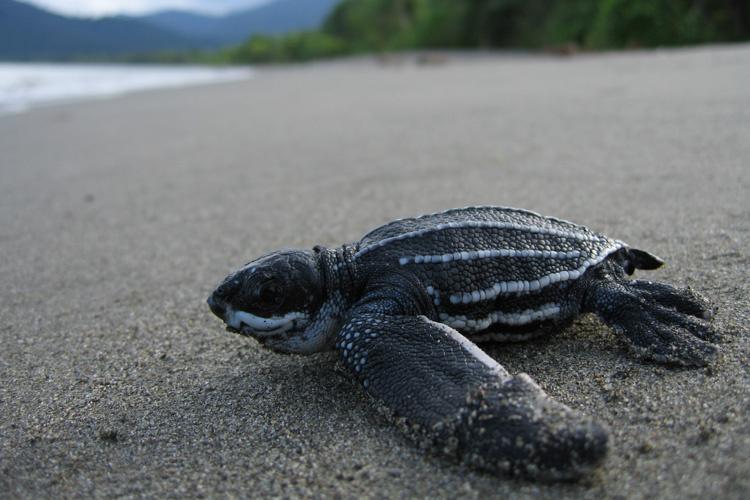 Leatherback turtle hatchling on beach. Credit: NOAA Fisheries
Leatherback turtle hatchling on embankment. Credit: NOAA Fisheries
About the Species
The leatherback sea turtle is the largest turtle in the earth. They are the merely species of body of water turtle that lack scales and a difficult trounce. They are named for their tough rubbery skin and accept existed in their current form since the age of the dinosaurs. Leatherbacks are highly migratory, some pond over 10,000 miles a year between nesting and foraging grounds. They are also accomplished defined with the deepest recorded dive reaching nearly 4,000 anxiety—deeper than near marine mammals.
The leatherback turtle has the widest global distribution of whatever reptile, with nesting mainly on tropical or subtropical beaches. Once prevalent in every ocean except the Chill and Antarctic, the leatherback population is rapidly failing in many parts of the world. They face up threats on both nesting beaches and in the marine environment. The greatest of these threats worldwide are incidental capture in fishing gear (bycatch), hunting of turtles, and collection of eggs for man consumption. The Pacific leatherback turtle populations are most at-risk of extinction. Pacific leatherbacks are one of nine ESA-listed species identified in NOAA'south Species in the Spotlight initiative. Through this initiative, NOAA Fisheries has made it a priority to focus recovery efforts on stabilizing and recovering Pacific leatherback populations in order to forestall their extinction.
NOAA Fisheries and our partners are dedicated to conserving and recovering leatherback turtle populations worldwide. Nosotros utilise a diverseness of innovative techniques to study, protect, and recover this endangered species. We engage our partners as we develop regulations and recovery plans that foster the conservation and recovery of leatherbacks and their habitats, and we fund research, monitoring, and conservation projects to implement priorities outlined in recovery plans.
Population Status
The leatherback ocean turtle is listed as endangered nether the Endangered Species Deed. It is estimated that the global population has declined 40 percent over the by three generations. Leatherback nesting in Malaysia has substantially disappeared, declining from about 10,000 nests in 1953 to simply 1 or 2 nests per year since 2003.
The Pacific leatherback turtle populations are near at-risk for extinction as evidenced past ongoing precipitous declines in nesting through their range. Primary nesting habitats of the Eastern Pacific leatherback turtle population are in Mexico and Costa rica, with some isolated nesting in Panama and Nicaragua. Over the last three generations, nesting in this region has declined by over 90 percentage. In the Western Pacific, the largest remaining nesting population, which accounts for 75 pct of the Western Pacific population, occurs in Papua Barat, Indonesia and has also declined by over eighty percent.
In the Northwest Atlantic, leatherback nesting was increasing; withal, there have been significant decreases in contempo years at numerous locations, including on the Atlantic coast of Florida, which is 1 of the main nesting areas in the continental United States. Large but potentially declining nesting populations also occur in the eastern Atlantic, forth the west African coastline, but doubt in the data limits our understanding of the trends at many of those nesting beaches.
The 2022 Condition Review of the leatherback sea turtle nether the ESA provides additional information on abundance and population trends.
Protected Status
ESA Endangered
- Throughout Its Range
CITES Appendix I
- Throughout Its Range
Advent
The leatherback has a primarily black, rubbery skin with pinkish-white coloring on its underside. They are the only species of sea turtle that lack scales. Their shell (carapace) consists of modest, interlocking dermal bones beneath the skin that overlie a supportive layer of connective tissue and fat and the deeper skeleton. Their carapace has seven ridges along its length and tapers to a blunt point. Their front flippers are proportionally longer than in other ocean turtles and their back flippers are paddle-shaped. Both their rigid carapace and their big flippers brand the leatherback uniquely equipped for long distance foraging migrations.
Behavior and Diet
Leatherback sea turtles undertake the longest migrations betwixt breeding and feeding areas of whatsoever sea turtle, some averaging 3,700 miles each style. They spend near of their lives in the body of water, simply females leave the water to lay eggs. Leatherbacks are strong swimmers and can dive to depths of approximately 4,000 feet—deeper than whatever other turtle—and can stay downward for upwardly to 85 minutes.
Leatherbacks lack the crushing, chewing plates characteristic of other body of water turtles that feed on hard-bodied prey. Instead, they have pointed molar-like cusps and sharp-edged jaws that are perfectly adjusted for a diet of soft-bodied open ocean casualty such as jellyfish and salps. A leatherback's mouth and throat also accept backward-pointing spines that assistance retain gelled prey.
Where They Live
Leatherbacks occur in the Atlantic, Pacific, and Indian Oceans. Nesting beaches are primarily located in tropical latitudes effectually the world. Globally, the largest remaining nesting aggregations are found in Trinidad and Tobago, W-Indies (Northwest Atlantic) and Gabonese republic, Africa (Southeast Atlantic).
Leatherbacks occupy U.S. waters in the Northwest Atlantic, West Pacific, and E Pacific. Inside the United States, the majority of nesting occurs in Florida, Puerto Rico, and the U.South. Virgin Islands. Leatherbacks have been satellite tagged at sea on foraging grounds off Nova Scotia, Canada and tracked to nesting beaches in the Caribbean. Western Pacific leatherbacks feed off the Pacific coast of Due north America, and migrate across the Pacific to nest in Republic of indonesia, Papua New Guinea, and the Solomon Islands. Eastern Pacific leatherbacks, on the other hand, nest along the Pacific coast of Mexico and Republic of costa rica, and forage in the south-central and eastern tropical Pacific Ocean.
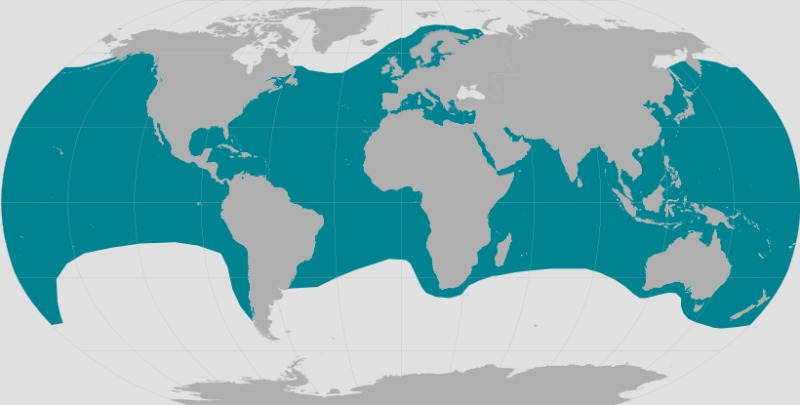 World map providing guess representation of the leatherback turtle's range.
Lifespan & Reproduction
Leatherback turtles grow faster than hard-shelled turtles. However, there is uncertainty about the historic period at which they reach sexual maturity. Boilerplate estimates range from ix to twenty years of age. Also, little is known about their life expectancy, but they are probable long-lived, with longevity estimates of 45 to 50 years, or more.
Female leatherbacks nest at night on tropical and subtropical beaches. They dig a big body pit to lay their eggs in deep egg chambers/nests. A nesting leatherback will disturb a huge expanse on the embankment and go out behind long, circling tracks. In the United States and Caribbean area, the nesting season lasts from March to July. Satellite tagging studies of leatherbacks from the Western Pacific betoken that turtles that nest during different times of the yr have unlike migration patterns. Summer nesting turtles (July through September) accept tropical and temperate northern hemisphere foraging regions, while winter nesters (November through February) traverse to tropical waters and temperate regions of the southern hemisphere. Female person leatherbacks return to nest every 2 to iv years. Leatherbacks nest several times during a nesting flavor, typically at 8- to 12-solar day intervals and lay clutches of approximately 100 eggs. The eggs incubate approximately two months before leatherback hatchlings emerge from the nest.
Threats
Bycatch in Fishing Gear
The primary threat to sea turtles is their unintended capture in line-fishing gear which can result in drowning or cause injuries that lead to death or debilitation (for example, swallowing hooks or flipper entanglement). The term for this unintended capture is bycatch. Bounding main turtle bycatch is a worldwide trouble. The primary types of gear that issue in leatherback turtle bycatch include gillnets, trawls, longlines, and vertical lines attached to pot/traps.
Directly Harvest of Turtles and Eggs
Historically, bounding main turtles including leatherbacks were killed for their meat and their eggs were collected for consumption. Presently, leatherback turtles are protected in many countries, but in some places, the killing of leatherbacks and collection of eggs continue.
Loss and Degradation of Nesting Habitat
Littoral development and rising seas from climatic change are leading to the loss of nesting beach habitat for leatherback turtles. Human-related changes associated with littoral development include beachfront lighting, shoreline armoring, and beach driving. Shoreline hardening or armoring (e.g., sea walls) tin result in the complete loss of dry sand suitable for successful nesting. Bogus lighting on and near nesting beaches can deter nesting females from coming ashore to nest and can disorient hatchlings trying to find the ocean subsequently emerging from their nests.
Vessel Strikes
Various types of watercraft tin can strike leatherback turtles when they are at or near the surface, resulting in injury or death. Vessel strikes are a major threat nigh ports and waterways, and side by side to highly developed coastlines. Vessel strikes are a significant crusade of leatherback strandings in the eastern Us.
Bounding main Pollution/Marine Debris
Increasing pollution of nearshore and offshore marine habitats threatens all sea turtles and degrades their habitats. The Deepwater Horizon oil spill was the largest offshore oil spill in U.S. history and affected nesting (including nesting females, eggs, and hatchlings), small-scale juvenile, large juvenile, and developed ocean turtles throughout the Gulf of United mexican states. Ingestion of marine debris is another threat to all species of sea turtles. Leatherback turtles may ingest line-fishing line, balloons, plastic bags, floating tar or oil, and other materials discarded by humans which they can error for nutrient. They may also become entangled in marine debris, including lost or discarded fishing gear, and can be killed or seriously injured.
Climate change
For all sea turtles, a warming climate is probable to result in changes in beach morphology and college sand temperatures which can be lethal to eggs, or change the ratio of male and female hatchlings produced. Rising seas and storm events cause beach erosion which may flood nests or launder them away. Changes in the temperature of the marine environment are likely to alter the affluence and distribution of nutrient resources, leading to a shift in the migratory and foraging range and nesting season of leatherbacks.
Scientific Classification
| Kingdom | Animalia |
|---|---|
| Phylum | Chordata |
| Class | Reptilia |
| Order | Testudines |
| Family unit | Dermochelyidae |
| Genus | Dermochelys |
| Species | coriacea |
What We Do
Conservation & Management
Since 1977, NOAA Fisheries and the U.South. Fish and Wildlife Service take shared jurisdiction of body of water turtles listed under the ESA. A Memorandum of Understanding outlines our specific roles: NOAA Fisheries lead the conservation and recovery efforts for ocean turtles in the marine environment, and the U.S. FWS lead conservation and recovery efforts for sea turtles on nesting beaches.
Nosotros are committed to the protection and conservation of leatherback turtles by:
- Working with partners to ensure compliance with national, country, and U.Due south. territory laws to protect body of water turtles
- Cooperating with international partners to implement conservation measures and establish agreements, such equally international treaties that protect ocean turtles
- Researching, developing, and implementing changes to fishing gear practices and/or fishing gear modifications (e.yard., turtle excluder devices), using large circumvolve hooks in longline fisheries, and implementing spatial or temporal closures to avoid or minimize bycatch
- Designating critical habitat areas essential for the conservation of leatherback turtles
- Protecting and monitoring leatherback turtles in the marine environment and on nesting beaches
- Conducting enquiry on threats and developing conservation measures that reduce threats and promote recovery
- Collecting information on the species biological science and ecology to better inform conservation management strategies and to assess progress toward recovery
- Conducting and supporting education and outreach efforts to the general public by raising awareness on threats to body of water turtles, highlighting the importance of sea turtle conservation, and sharing ways people can aid body of water turtles
Learn more about our conservation and management efforts
Scientific discipline
Nosotros bear various research activities on the biology, behavior, and ecology of leatherback sea turtles. The results of this research are used to evaluate population trends, inform conservation direction strategies, and to appraise progress toward recovery for this imperiled species. Our work includes:
- Monitoring populations through vessel-based or aeriform surveys, nesting beach studies, satellite tracking, genetics, and mark-recapture (flipper tagging) studies
- Studying foraging and reproductive behavior to sympathize demographics, physiology, habitat utilize, and resource requirements
- Tracking individuals over time to sympathize important aspects of their life history such as growth and age to maturity
- Evaluating life history and population health information from stranding and fisheries bycatch datasets
- Understanding impacts of change in environmental and ocean conditions on sea turtle abundance, distribution, and demographics
- Estimating population abundance and analyzing trends
- Monitoring fisheries impacts and designing line-fishing gear to minimize bycatch during commercial and recreational fishing operations
- Capacity building and preparation to share the latest scientific techniques and tools to monitor sea turtle populations globally
Larn more about our enquiry
How You Can Help

Reduce Ocean Trash
Reduce marine debris and participate in littoral make clean-up events. Responsibly dispose of angling line - lost or discarded fish line kills hundreds of bounding main turtles and other animals every twelvemonth. Trash in the environs can terminate upwardly in the ocean and impairment marine life.
Reduce plastic use to keep our beaches and oceans make clean—deport reusable water bottles and shopping bags.
Refrain from releasing balloons —they tin end upward in the ocean where sea turtles can mistake them for casualty like jellyfish or go entangled in lines.
Learn more about marine debris
Keep Your Altitude
Admire body of water turtles from a respectful altitude by land or bounding main and follow these guidelines:
Don't disturb nesting turtles, nests, or hatchlings. If interested, attend organized sea turtle watches that know how to safely observe bounding main turtles.
Never feed or attempt to feed or touch sea turtles equally it changes their natural behavior and may brand them more susceptible to impairment.
Gunkhole strikes are a serious threat to sea turtles. When canoeing, watch for sea turtles in the water, slow downwards, and steer around them . If you encounter them closer than 50 yards, put your engine in neutral to avert injury. Recollect, Go Tedious, Sea Turtles Beneath!
Acquire more nearly our marine life viewing guidelines

Protect Sea Turtle Habitat
Beaches are paramount for good for you sea turtle populations since females come to the shore to deposit their eggs into nests.
Keep nesting beaches dark and safe at dark. Plow off, shield, or redirect lights visible from the beach—lights disorient hatchlings and discourage nesting females from coming onto beaches to lay their eggs.
Afterward a day at the beach, remove recreational embankment equipment like chairs and umbrellas and so ocean turtles are not entrapped or turned abroad. Also, fill up in holes and knock down sandcastles before you leave—they tin become obstacles for nesting turtles or emerging hatchlings.
Do non bulldoze on body of water turtle nesting beaches—vehicles tin deter females from nesting, directly strike hatchlings and nesting turtles, damage incubating nests, and create ruts that prevent hatchlings from reaching the sea.

Report Marine Life in Distress
-
Featured News
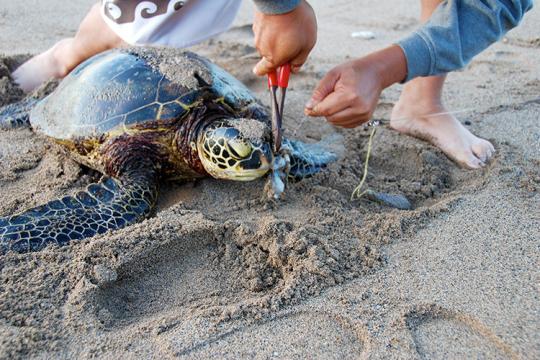 Fishermen: Itʻs OK to help a hooked dark-green sea turtle by cutting off the line as close to the hook as possible. Credit: NOAA Fisheries
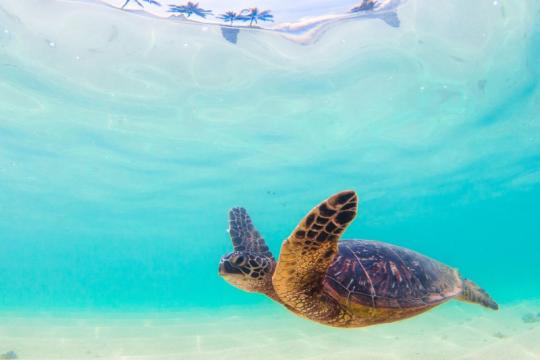 Hawaiian green sea turtle. Credit: iStock.
 A fishing coiffure in Alaska rescued this greenish sea turtle from getting caught in a net only south of Prince of Wales Island on Aug v, 2022. Photo credit: Ben Dolph.
Management Overview
Leatherback turtles are protected under the Endangered Species Human activity and listed equally endangered. This means that the leatherback turtle is in danger of extinction throughout all or a significant portion of its range. NOAA Fisheries is working to protect and recover this species in many ways, with the goal of conserving and recovering the species worldwide.
In the Us, NOAA Fisheries and the U.S. Fish and Wild fauna Service have articulation jurisdiction for sea turtles, with NOAA having the lead in the marine environment and U.South. FWS having the lead on the nesting beaches. Both federal agencies, along with many state and U.S. territory agencies and international partners, are working together to conserve and recover sea turtles and have issued regulations to eliminate or reduce threats to bounding main turtles.
Recovery Planning and Implementation
Recovery Activeness
To assistance identify and guide the protection, conservation, and recovery of sea turtles, the ESA requires NOAA Fisheries and the U.S. FWS to develop and implement recovery plans which provide a pattern for conservation of the species and measurable criteria to gauge progress toward recovery.
The major recovery actions for leatherback turtles include:
- Protecting ocean turtles on nesting beaches and in marine environments
- Protecting nesting and foraging habitats
- Reducing bycatch in commercial, artisanal, and recreational fisheries
- Reducing the effects of entanglement and ingestion of marine droppings
- Reducing vessel strikes in coastal habitats
- Working with partners internationally to protect turtles in all life-stages
- Supporting enquiry and conservation projects consistent with Recovery Plan priorities
Ii recovery plans take been developed to recover and protect leatherback turtle populations found in U.Southward. waters. Each is focused on the unique needs of leatherback turtles in the various regions.
- Recovery Plan for the U.S. Caribbean, Atlantic, and Gulf of Mexico Populations of the Leatherback Bounding main Turtle
- Recovery Plan for the U.S. Pacific Populations of the Leatherback Sea Turtle
The highly migratory behavior of sea turtles makes them shared resources among many nations, so conservation efforts for sea turtle populations must extend beyond national boundaries. This necessitates international collaboration and coordination. Learn more about international conservation efforts beneath.
Implementation
NOAA Fisheries is working to minimize effects from man activities that are detrimental to the recovery of leatherback turtles in the Us and internationally. Together with our partners, nosotros undertake numerous activities to support the goals of the leatherback turtle recovery plans, with the ultimate goal of species recovery.
Efforts to conserve leatherback turtles include:
- Protecting habitat and designating critical habitat
- Reducing bycatch
- Rescue and disentanglement
- Eliminating the killing of turtles and the drove of their eggs
- Eliminating the harassment of turtles on nesting beaches and foraging habitats through educational activity and enforcement
- Consulting with federal agencies to ensure their activities are non likely to jeopardize the continued being of listed species
Pacific leatherbacks are one of NOAA Fisheries' Species in the Spotlight.
Critical Habitat
Once a species is listed under the ESA, NOAA Fisheries evaluates and identifies whether whatever marine areas meet the definition of disquisitional habitat. Those areas may be designated equally critical habitat through a rulemaking procedure. A disquisitional habitat designation does not set upward a marine preserve or refuge. Rather, federal agencies that undertake, fund, or allow activities that may bear upon designated critical habitat areas are required to consult with NOAA Fisheries to ensure that their actions practise non adversely modify or destroy these designated critical habitats.
In 1979, NOAA Fisheries and the U.S. FWS designated critical habitat for endangered leatherback turtles for littoral waters adjacent to Sandy Indicate in St. Croix, U.S. Virgin Islands. In 2022, NOAA Fisheries as well designated critical habitat for endangered leatherbacks forth the west coast of the United States.
View the leatherback turtle critical habitat map for the U.S. Virgin Islands
View the leatherback turtle critical habitat map for the U.S. West Coast

Leatherback sea turtle swimming at body of water surface. Credit: NOAA Fisheries
Conservation Efforts
Reducing Bycatch
NOAA Fisheries is working to reduce the bycatch of sea turtles in commercial fisheries. Our efforts are focused on documenting bycatch, understanding how, why, and where sea turtles are bycaught, and how to reduce that bycatch. We have developed modifications to fishing gear and practices to reduce bycatch and/or reduce bycatch injuries. We crave these modifications in certain U.Southward. commercial fisheries including gillnets, longlines, pound nets, scallop dredges, and trawls that accidentally take hold of sea turtles. Measures include:
- Gear modifications
- Changes to fishing practices
- Time/expanse closures
In the United States, NOAA Fisheries has worked closely with the shrimp trawl fishing industry to develop turtle excluder devices (TEDS) to reduce the mortality of sea turtles bycaught in shrimp trawls. TEDs are required in the shrimp otter trawl fishery and, in early 2022, in larger vessels participating in the skimmer trawl fishery.
Since 1989, the United States has prohibited the importation of shrimp harvested in a manner that adversely affects sea turtles. The import ban does not apply to nations that have adopted bounding main turtle protection programs comparable to that of the U.S. (i.eastward., require and enforce the use of TEDs) or to nations where bycatch in shrimp fisheries does not present a threat to sea turtles (for example, nations that fish for shrimp in areas where sea turtles do not occur). The U.Southward. Section of Land is the main implementing agency of this police while NOAA Fisheries serves every bit technical advisor and provides extensive TED training throughout the world.
Nosotros are also involved in cooperative gear research projects, implementation of changes to gear and fishing practices, and safe handling protocols designed to reduce sea turtle bycatch and mortality in the Gulf of Mexico and Atlantic pelagic longline fisheries, the American Samoa and Hawaii-based longline fisheries, the Atlantic sea scallop dredge fishery, and non-shrimp trawl fisheries in the Atlantic and Gulf of United mexican states.
Fisheries Observers
Bycatch in fishing gear is the primary human-acquired source of sea turtle injury and mortality in U.South. waters. The most effective fashion to learn well-nigh bycatch is to place observers aboard fishing vessels. Observers collect important information that allows us to empathize the amount and extent of bycatch, how turtles collaborate with the gear, and how bycatch reduction measures are working.
NOAA Fisheries determines which fisheries are required to carry observers, if requested to do and so, through an annual determination. Observers may besides be placed on fishing vessels through our authorities nether the Magnuson-Stevens Act.
Responding to Strandings and Entanglements
A stranded bounding main turtle is 1 that is found on country or in the water and is either dead or is alive but unable to undergo normal activities and behaviors due to an injury, illness, or other problem. Virtually strandings are of private turtles, and thousands are documented annually forth the coasts of the U.s.a. and its territories. Organized networks of trained stranding responders are authorized to recover dead turtles or assist live turtles and document of import data near the causes of strandings. These networks include federal, state, and private organizations. The actions taken by stranding network participants improve the survival of sick, injured, and entangled turtles while also helping scientists and managers expand their knowledge about threats to sea turtles and causes of mortality.
Because bounding main turtles spend most of their life at bounding main and out of sight, data learned from strandings are an important way for us to place and monitor bug that threaten sea turtle populations.
Within the United States and its Territories, there are 3 regional networks that serve to document and rescue stranded and entanglement sea turtles:
- Atlantic Ocean, Gulf of United mexican states, and Caribbean: Coordinated under the Sea Turtle Stranding and Save Network (STSSN)
- Pacific Body of water (continental U.S. West Coast): Coordinated past NOAA'southward W Coast Regional Function
- Pacific Islands (Hawaii, American Samoa, Guam, and the Democracy of the Northern Mariana Islands): Coordinated by NOAA's Pacific Islands Fisheries Scientific discipline Center and the Pacific Islands Regional Function
The actions taken by stranding network participants better the survivability of sick, injured, and entangled turtles while besides helping scientists and managers to expand their knowledge almost diseases and other threats that bear on sea turtles in the marine environment and on land.
International Conservation Efforts
The conservation and recovery of sea turtles requires international cooperation and agreements to ensure the survival of these highly migratory animals. Nosotros work closely with partners in many countries across the world to promote body of water turtle conservation and recovery. Two international agreements specifically focused on ocean turtle conservation are:
- Indian Ocean - Due south-East Asian (IOSEA) Marine Turtle Memorandum of Agreement
- Inter-American Convention (IAC) for the Protection and Conservation of Sea Turtles
Boosted international treaties and agreements that also protect sea turtles include:
- Convention on International Trade in Endangered Species (CITES): Listed in Appendix I, which prohibits international trade of wild flora and brute
- Cartagena Convention: Protected under Annex 2 of the Particularly Protected Areas and Wild fauna (SPAW) Protocol
Regulatory History
The leatherback turtle was first listed under the ESA in 1970. In 2022, NOAA Fisheries and U.South. FWS received a petition to identify the Northwest Atlantic leatherback subpopulation every bit a DPS and list information technology as threatened under the ESA. We found that the petitioned action may exist warranted and conducted a global status review. After evaluating the all-time available science and conservation efforts on behalf of the species, nosotros adamant that the petitioned actions were not warranted considering all leatherback populations meet the definition of an endangered species. Therefore, as we described in the 2022 12-calendar month finding, the leatherback turtle remains listed equally an endangered species under the ESA.
In 1992, nosotros finalized regulations to require turtle excluder devices (TEDs) in shrimp trawl fisheries to reduce sea turtle bycatch. Since then, nosotros have updated these regulations as new information became available and TEDs were modified to amend their turtle exclusion rates. TEDs are as well required in the summertime flounder fishery in certain areas along the Atlantic coast of the The states.
Nosotros have also implemented other measures to reduce sea turtle bycatch in fisheries through regulations and permits nether both the ESA and Magnuson-Stevens Act. These requirements include the use of large circumvolve hooks in longline fisheries, time and expanse closures for gillnets, and modifications to pound net leaders and Atlantic sea scallop dredges.
See all regulations to protect sea turtles
Key Actions and Documents
Published
Effective
Science Overview
NOAA Fisheries conducts research on the biology, beliefs, and ecology of the leatherback sea turtle. The results of this research are used to inform management decisions and enhance recovery efforts for the species.
Population Assessments
Sea turtle population assessments ideally include information on the species' abundance and distribution, life history, and man impacts. This information can help NOAA Fisheries evaluate the effectiveness of conservation and recovery measures, and can help guide deportment to heighten recovery. To judge population abundance, researchers conduct aerial and vessel-based surveys of selected areas and capture and mark turtles in the water and on beaches. Nosotros also incorporate data nerveless on nesting beaches via stranding networks and fromfisheries observer programs. Other data that informs sea turtle population assessments includes population structure (genetic analyses), historic period to maturity, survivorship of the various life stages (e.one thousand., hatchling, juvenile, adult) foraging and reproductive behavior, movement and distribution, and habitat studies.
Tagging and Tracking Studies
Satellite telemetry allows researchers to track sea turtles as they migrate between and within foraging and nesting areas. Tags are designed and attached in a manner that minimizes disturbance and/or harm to the turtle. The data help u.s. empathize migration patterns, identify feeding areas, and place where turtles overlap with their primary threats (east.g., fisheries, vessel traffic).

NOAA Fisheries' scientists began tracking Pacific leatherbacks from central California foraging grounds in 2000, and have expanded these studies to the nesting beaches in the western Pacific later documenting that the California turtles originated from there. Learn more about tagging and tracking of leatherbacks in the Pacific:
- Long-Range Migrations and Habitats
- Tagging Enquiry in Papua New Guinea
- Movements from Nesting to Feeding Areas Across the Pacific
Enquiry to Reduce Bycatch in Fishing Gear
We observe fisheries to empathize the level of sea turtle bycatch and the ways in which turtles interact with fishing gear. We work with partners and industry to develop modifications to fishing gear and/or angling practices to reduce sea turtle bycatch while at the same fourth dimension retaining a sustainable grab of targeted species. These efforts include the development of turtle excluder devices (TEDs) for use in trawl fisheries, use of circle hooks and certain allurement types in longline fisheries, time and area closures/mesh size restrictions and low profile designs for gillnets, and modifications to pound net leaders.
Learn more than about our angling gear research
Sea Turtle Genetics
NOAA Fisheries' National Sea Turtle Molecular Genetics Middle serves equally a worldwide primal repository for sea turtle tissue and DNA samples and constitutes a major area of research supporting body of water turtle conservation. For case, a turtle'southward genetic "fingerprint" can be used to make up one's mind which nesting population it originated from.
Learn more about our turtle genetics and isotope studies
Critical Habitat - Maps and GIS Data (West Coast Region)

Protected Resources App
Source: https://www.fisheries.noaa.gov/species/leatherback-turtle
0 Response to "How To Set Up A Turtle Habitat"
Post a Comment