

5G won't matter until carriers and phone makers address these issues
5G won't matter until carriers and phone makers accost these bug

History is rife with examples of new technologies that stumbled out of the gate, and 5G is unfortunately among them. While information technology's non unusual for perceived innovations to come short at launch, wireless carriers spent so much attempt hyping 5G networks, without producing any tangible benefit to customers to date, that it's well-nigh become a joke at this betoken.
One day, gigabit-class downloads and minimal latency will exist the norm for cellular networks all over the earth. However, that day is not today, and until nosotros get there, we're left to contend with 5G in the disjointed state it's in now, where the feel of actually using the faster networking standard never quite matches up to the hyperbole.
- The best 5G phones available now
- The best unlocked phones at every price
- Plus: The iPhone 12 design we really desire just appeared
Here at Tom'southward Guide, nosotros've been testing 5G networks from all the major carriers since their inception more than a year ago. Thus, we've had a lot of fourth dimension to mull over our most frustrating pet peeves; here are the 5G annoyances that rising to the top, and that will need to be addressed if the technology is ever to have off.
5G is either slow, or doesn't reach that far
Part of the large problem with 5G is that information technology's billed every bit one applied science even though it actually isn't at this point. Generally speaking, there are 2 forms of 5G: sub-6GHz 5G and millimeter-wave 5G (mmWave) — though you could split that pie further if you like.
Sub-6GHz 5G operates much the same way conventional LTE networks practise. Coverage is comparable to LTE, while speeds should be a chip faster ideally. Unfortunately though, the current performance of these 5G networks is so similar to LTE that it'due south not unusual to experience slower speeds on a sub-6GHz 5G connection compared to what y'all'd get on the same carrier's latest-and-greatest LTE Advanced network. In fact, a March survey of 5G performance beyond the U.Due south. conducted by RootMetrics establish that the maximum LTE speeds recorded in Los Angeles actually surpassed those of sub-6GHz 5G networks, and by a considerable margin.
So what about mmWave 5G? When you see an ad from Verizon ad 1Gbps-plus downloads, what the carrier is talking most is mmWave. This infrastructure offers unprecedented speed, and that'due south not an exaggeration. We recorded i.85Gbps using a Samsung Galaxy Note 10 5G when Big Red flipped on its mmWave service in Los Angeles terminal December. That immune us to download PUBG Mobile from the Google Play Shop — a one.64GB game — in just 38 seconds. Over a adept LTE connectedness, you lot'd still probably await at to the lowest degree ten minutes to pull downwards a file that bulky.

The problem with mmWave, however, is that it only works over short distances, which is why you're unlikely to encounter it exterior of cities or indoor spaces with lots of pes traffic, like airports or sporting venues. You besides demand an uninterrupted line of sight between your device and the mmWave node you're connecting to; if that link is obstructed in whatever style, y'all're either losing your mmWave connectedness entirely, or at least going to run into speeds fall dramatically. And latching onto a mmWave signal outdoors from inside a building or even through a window is simply out of the question.
Now, one potential answer to this could exist mid-ring 5G, which actually falls nether the sub-6GHz label, all the same is only actually employed by Sprint (and slowly coming to T-Mobile). Sprint'south two.5GHz deployment of 5G strikes a decent residuum between speed and range. When we tested it in Chicago terminal year, we found information technology to be noticeably faster than the Now Network'due south LTE infrastructure, at a slight but non profound price to coverage. For what it's worth, we could even connect indoors, which is more than can be said for mmWave 5G.
5G-ready phones come with big drawbacks
If you've got a long memory, you might call up the first wave of 4G LTE phones about a decade ago. Those devices were capable of some astonishing information speeds for their time, but had all the endurance of a thoroughbred at the Kentucky Derby.
Fortunately, over fourth dimension LTE modems became more power-efficient, and smartphone battery sizes grew to continue them running longer. The first and 2d wave of 5G devices aren't quite every bit hopeless as those early on LTE ones, though they have kinks that need to be worked out.

Starting time, there'due south the issue of phone size and bombardment life. Millimeter-moving ridge radios have up boosted space and consume a lot of power. Not simply practice phones that incorporate them need to be bigger to fit the connectivity gear itself, but the batteries typically take to increment in kind. That's why Samsung wasn't able to shoehorn mmWave tech into the "pocket-size" 6.4-inch Milky way S20 (though it's supposedly figured out a solution for the Verizon variant that's now available).
In other words, if you prefer the all-time small phones, you're not going to like making the bound to 5G, at least for a little while. Information technology'southward rumored that the entry-level iPhone 12 that Apple tree is expected to launch in the autumn with a 5.4-inch display will lack mmWave support, likely due to space constraints and also to continue prices low.
2nd, 5G phones remain somewhat expensive. They're coming down in toll from where they began, of form, and this summertime we'll begin to meet unlocked 5G handsets with the ability to connect to sub-6GHz networks for $500, like the upcoming TCL 10 5G and Samsung Milky way A51 5G. But if you want a premium 5G phone with back up for both sub-6GHz and mmWave 5G, you lot're going to be paying somewhere in the neighborhood of $900 or $1,000 for the foreseeable future.
Carriers' mixed messaging is poisoning the well
5G is confusing, and we all know information technology. However, it'd exist a lot less confusing if carriers would save their needless branding and be honest almost what they're offer, how, and to whom.
The well-nigh egregious example of this is, of course, AT&T, whose 5GE "service" made just nearly everyone scratch their heads when information technology began rolling out in late 2018. 5GE, which stands for 5G Evolution, is really no different from AT&T'south existing LTE Advanced network. However, because sub-6GHz 5G is congenital upon the underpinnings of LTE, and uses technologies like 256 QAM and 4x4 MIMO, the carrier evidently felt justified in branding its most sophisticated LTE smartphones as 5GE-enabled devices instead.
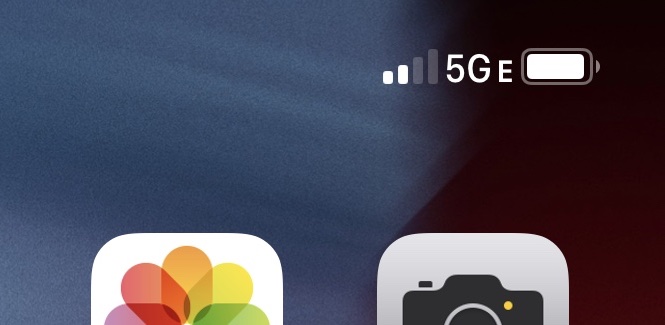
On a semantic level, the name 5G Evolution is irritating. Not only does it propose that the network is 5G fifty-fifty though it isn't, but oftentimes in technology, an evolution connotes a development or an improvement upon an existing production — and even so 5GE doesn't even qualify as basic 5G. AT&T is finally relenting on advertizing 5GE, thanks to a National Advertising Division ruling, but the visitor is unfortunately still committed to leaving the 5GE indicator on devices where it'south already present.
Merely AT&T's not the only i at fault hither. Verizon is insistent upon calling its 5G deployment "Ultra Wideband 5G" which, in the carrier'southward defense, does qualify as a technical term for mmWave. Simply AT&T calls that same applied science "5G+" while T-Mobile has no unique branding for its ain mmWave 5G. At a certain point, you just wish all iii carriers would come up together on some sort of consistent nomenclature, considering information technology only serves to hurt them all if customers can't understand the nature of their networks.
The "revolution" is ages abroad
You could make a lethal drinking game out of taking sips every time a carrier mentions 5G in relation to changing the world or revolutionizing connectivity in its marketing materials.
Certain, the theoretical speed and latency improvements 5G will bring should enable use cases that were never thought possible before. Cocky-driving vehicles that communicate with each other instantaneously, besides equally with traffic lights and systems, was a distant dream earlier 5G gained steam, but today there's a path forrard. From smart cities, to healthcare, to manufacturing, the theme is that the exponentially broader bandwidth and instantaneous response that 5G offers has the potential to reshape every aspect of our lives.
Until carriers make adept on their promises, 5G volition keep to wait like a failure to the public.
Simply of grade, that won't happen tomorrow; it might not fifty-fifty happen in the next decade, or longer. And until those other annoyances of existing 5G are chipped away, one by one, the 5G "revolution" will remain a vague promise of a utopia with no ETA.
What'south more than, this is a promise that carriers and telecoms are continually repackaging and shipping just to sell their partners and the public on 5G today. The proliferation of 5G was always going to be a long game — at that place's no solving that. But the hype does create an expectation among the masses that 5G was supposed to change everything, and for every 24-hour interval that passes until it does, it'll continue to be an apple-polishing failure.
And that pessimism has dangerous repercussions, similar fostering toxic ideas that 5G is a highly-experimental, otherworldly technology that can give you final illnesses — or, worse however, was actually designed by governments to command populations. Of grade, all new technology is scary (and a new technology in the historic period of a global pandemic, doubly so!) But if the industry doesn't atmosphere expectations, disappointment or, in extreme cases, fearfulness surrounding 5G will merely continue to spread well earlier the networks do.
5G outlook
The good news is that our disappointment with the performance of 5G networks and the devices that connect to them will eventually subside with time. Infrastructure will aggrandize, networks will become more reliable and faster, and the relevant components in smartphones will slide in toll to the point when you'll exist able to pick upwards a budget 5G device. Both those realities might be a few years off, but somewhen, they'll come up to pass.
The existent challenge lies with those more philosophical problems that inhibit 5G. Some of information technology we'll undoubtedly figure out as we go along — simply the time to educate and demystify 5G is at present, non later on.

Source: https://www.tomsguide.com/opinion/biggest-5g-annoyances
Posted by: howardclarm2002.blogspot.com
0 Response to "5G won't matter until carriers and phone makers address these issues"
Post a Comment